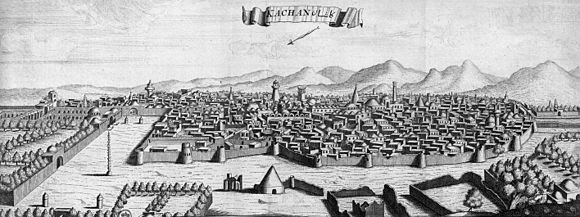
Kashan and the History of Textiles
Named by the UNESCO World Crafts Council as a “World City of Traditional Textiles" in 2023, the city of Kashan constitutes one of Iran’s oldest settlements, with the Sialk Hills archaeological site containing traces of civilisation from more than 7.000 years ago. Next to ceramics and copper vessels found on site, textiles and textile weaving equipment such as bathing cloths or stone spindles are proof that weaving has been part of this region for multiple millennia.
Kashan expanded during the Seljuk Era in the 11th - 13th century and established itself as a merchant city, a wall rising to contain a mosque, a historical Bazaar complex, caravanserais, cistern-based irrigation and bathhouses. It was during this period that Kashan became a sought-after destination for its ceramics, copper, and exquisite textiles.
Various travellers across the centuries, from Marco Polo, Antione Shirley and Knight Chardin to André Godard, have all praised Kashan velvets, gold brocades and silk carpets as the base of wealth and prosperity in this region.
Lined with vast mulberry gardens for silk production, Kashan was once home to the entire production chain for the finest fabrics: from raising silk worms to processing cocoons and dyeing, to the "Zarkesh-Sarays" where gold and silver was spun around silk cores, all the way to various weaving and carpet knitting workshops which produced the finest brocades, velvets, silk fabrics and carpets to be sold in the Kashan Bazaar. Until not so long ago, traces of at least one of the steps involved in creating textiles - spinning yarn, dyeing, warping or weaving itself - were found in almost every household in Kashan.
It is quoted that in the 11th century, several hundred weaving workshops were active in Kashan. This number fell drastically over the centuries, with only 40 workshops remaining in the Qajar period, and the industry coming close to extinction with the industrialisation of textile manufacture, imports from Europe and a lack of adequate government policies.
A combination of public and private efforts, the most significant of which have been spearheaded by Manouchehri House, have led to a small but hopeful revival in Kashan’s traditional textile manufacture, with silk, brocade and velvet workshops slowly opening their doors and mounting their looms in order to hopefully sustain and develop these precious components of Iranian tradition and history.
